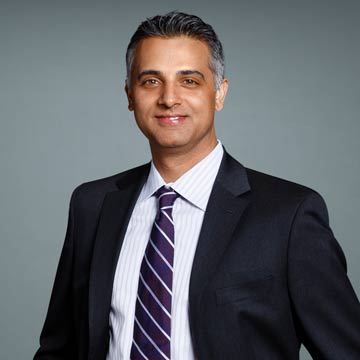

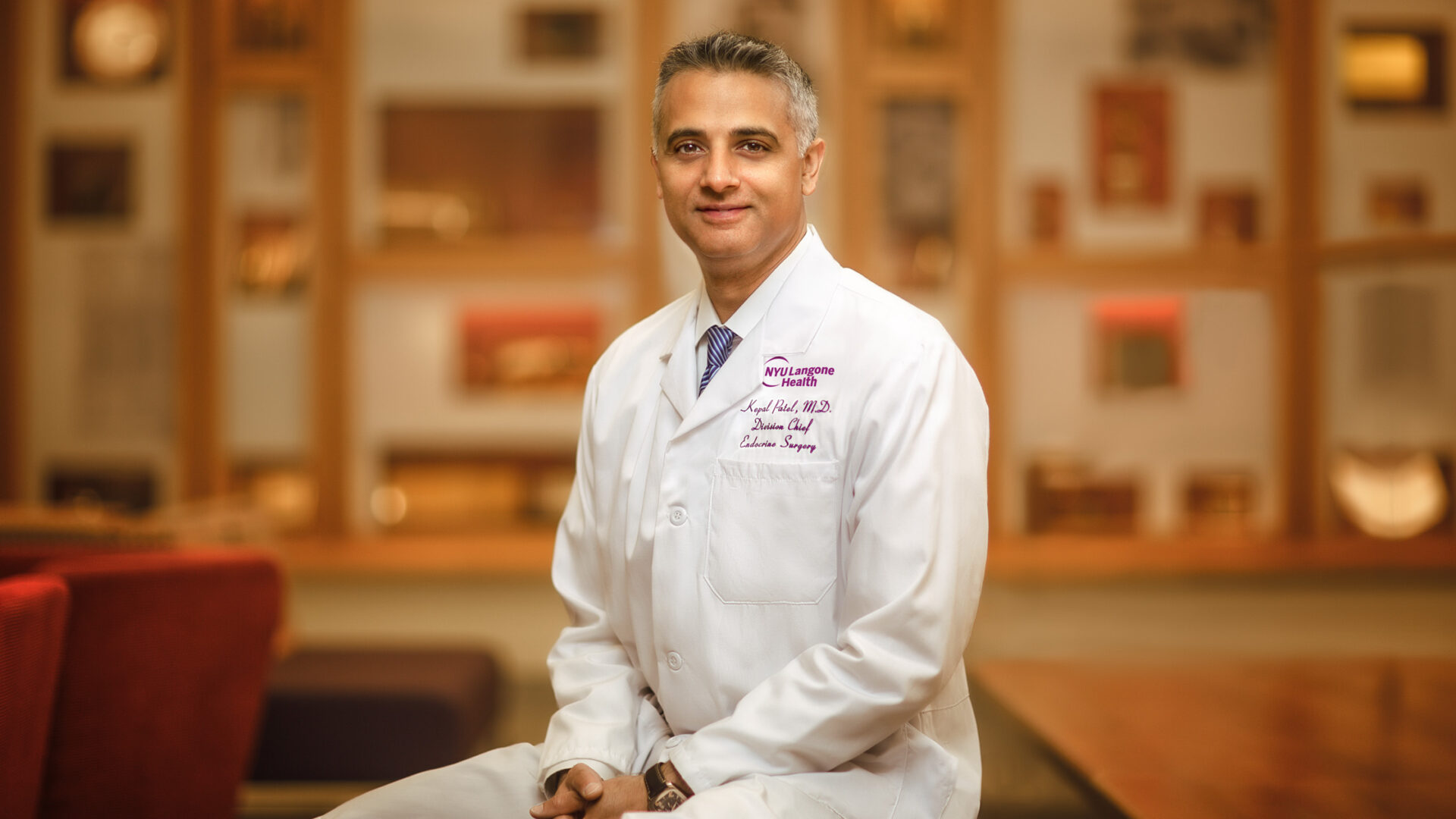
In October 2025, Kepal N. Patel, MD, chief of the Division of Endocrine Surgery and co-director of the Thyroid Program at NYU Langone Health, was elected to the board of directors of the American Thyroid Association (ATA). A distinguished surgeon and physician–scientist, Dr. Patel is widely regarded for his expertise in the multidisciplinary care of patients with benign and malignant thyroid disease, as well as his pioneering research into advanced therapies, including most recently, thermal ablative techniques.
With this appointment, Dr. Patel joins a prominent group of leaders in thyroid health who will help steer the ATA’s mission to advance research and care for thyroid disease.
Here, Dr. Patel shares his goals for this leadership position—with a focus on advancing minimally-invasive interventional technologies and supporting early-career scientists pursuing bench-to-bedside translational research.
Physician Focus: Congratulations on your new position. Reflecting on your training and experience, what prepared you for this role?
Dr. Patel: As an endocrine surgeon, my entire career has been dedicated to managing patients with thyroid disease. From early in my career, I have been interested in the molecular pathways that define thyroid cancer and the relationship between thyroid disease and the immune system. Moreover, the clinical practice we’ve developed here at NYU Langone, and our clinical expertise in managing patients with thyroid disease and thyroid cancer specifically has prepared me for this role, and it’s a true honor.
Physician Focus: What are the top goals you would like to accomplish during your term with the ATA?
Dr. Patel: One of the ATA’s core priorities is ensuring that new technologies are introduced safely and effectively to improve outcomes and quality of life. I’m excited to help shape that future.
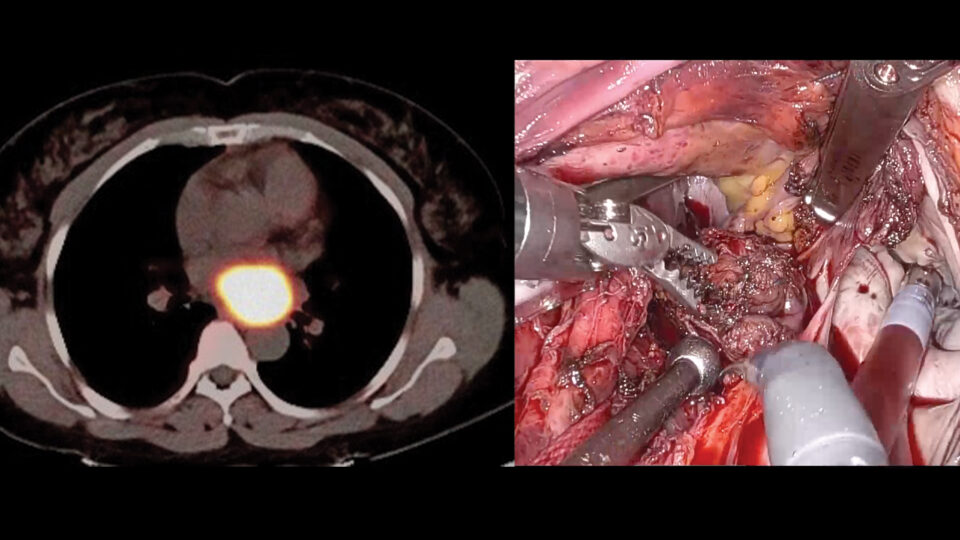
I have a strong interest in surgical and interventional innovation, focusing on novel, minimally invasive ways of managing patients who previously would have required traditional surgery. It’s been inspiring to see how advancements like remote access thyroid surgery, thermal ablative techniques, and interventions such as thyroid artery embolization have significantly improved quality of life for our patients.
And we certainly aren’t stopping there. Non-thermal ablation, histotripsy, and high-intensity focused ultrasound (HIFU) are just a few of the newer technologies on the horizon that I’m eager to champion in my own practice and in my role as board member.
“One of the ATA’s core priorities is ensuring that new technologies are introduced safely and effectively to improve outcomes and quality of life. I’m excited to help shape that future.”
Kepal N. Patel, MD
We’re gradually moving into a Star Trek–style era of thyroid nodule management—where you can imagine waving a tricorder over a patient’s neck and identifying and treating thyroid tumors or nodules directly. I’m being facetious, but it’s exciting to consider how thyroid care will evolve in the coming years as our field continues to adopt ever more minimally invasive technologies.
Physician Focus: Speaking of new technologies, do you have a vision for the role of artificial intelligence (AI) in thyroid disease management?
Dr. Patel: When patients walk into our office with a thyroid nodule, they’re mostly interested in knowing: Do I have cancer? If I do, is it aggressive? Is it treatable? What kind of quality of life will I have? AI will be important to help us integrate clinical findings, imaging data, cytology, pathology, and genomic sequencing, to provide a risk stratification that answers these and other important questions quickly.
“It’s exciting to consider how thyroid care will evolve in the coming years as our field continues to adopt ever more minimally invasive technologies.”
Physician Focus: Which areas of thyroid disease research are making significant strides, and where could additional focus lead to further breakthroughs?
Dr. Patel: One of the most impactful research areas right now is in the treatment of aggressive thyroid cancers, such as anaplastic thyroid cancer. Until just five years ago, these cancers were almost uniformly fatal, with most patients surviving no more than 6 to 12 months. Now, with a combination of targeted drugs, surgery, radiation, and immunotherapy, we’re able to control this disease to the point in which some patients are surviving five years or more. We’ve also made great strides with treating thyroid nodules and smaller cancers without surgery.
But there’s still a lot of work that needs to be done, especially in the areas of pediatric thyroid disease, autoimmune thyroid disease, and thyroid eye disease (TED), where more research is needed to advance treatment options.
Providing funding and support for our early career scientists, to help bring new therapies into clinical practice, is a critical mission of the ATA that I look forward to championing.