
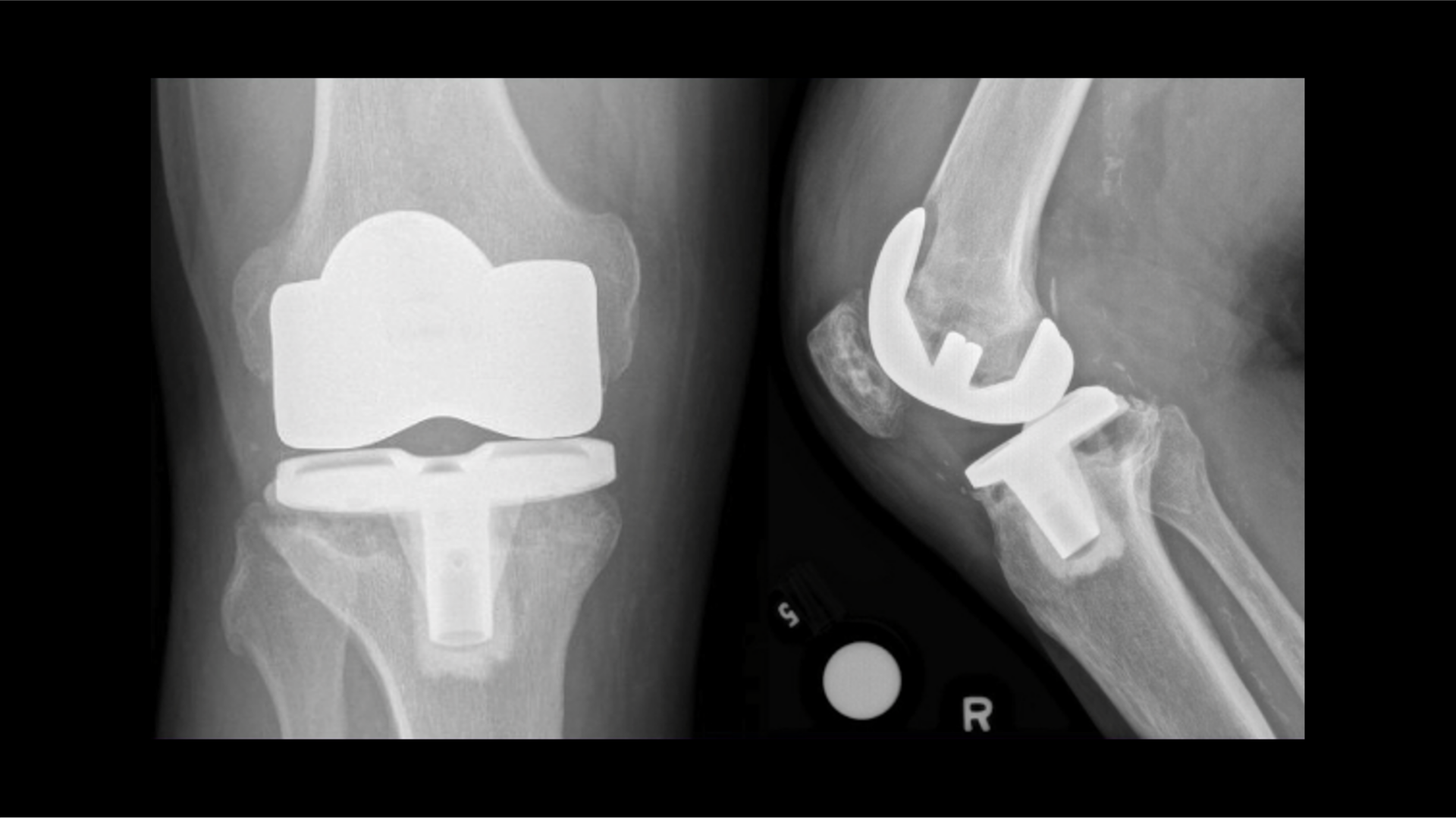
A 75-year-old patient presented with chronic knee pain and stiffness following right total knee arthroplasty performed at an outside institution two years prior. Radiographs demonstrated a cemented total knee arthroplasty with significant scalloping osteolysis involving the femoral and tibial components at the cement–implant interface, suggesting septic loosening. Laboratory findings further supported chronic periprosthetic joint infection.
The team proceeded with a one-stage exchange arthroplasty, using methylene blue to guide thorough synovectomy and debridement for infection eradication. Notably, after component removal, extensive and complete debridement of all methylene blue-stained cement, tissue, and bone was performed before placement of revision components. At 3 months, the patient was walking without pain or assistive devices.
“The key to success in the surgical treatment of any prosthetic joint infection is debridement, and most failed debridements are in the back of the knee,” said Vinay K. Aggarwal, MD, while presenting the case at the American Academy of Orthopaedic Surgeons (AAOS) 2026 Annual Meeting.
Watch the video below to learn more about the case.