
Referral Notes:
- Early-career investigators at the Colton Center are pioneering discoveries in VEXAS syndrome, generating new insights into the role of PD-1 in autoimmunity, and applying a novel AI application to study psoriatic arthritis.
- Collaborations with the international Colton Consortium for Autoimmunity are leveraging AI models across electronic health records to map the landscape of autoimmune disease.
- Partnerships with engineering teams have led to a microfluidic synovium-on-a-chip device that provides a novel model of human synovial tissue.
The prevalence of autoimmune disease is on the rise, putting NYU Langone Health’s Judith and Stewart Colton Center for Autoimmunity at the heart of an urgent effort to better understand, diagnose, and treat the growing family of conditions. Since 2015, the center has become a world leader in advancing conceptual frameworks for studying autoimmunity; in mentoring, funding, and supporting talented young researchers; and in promoting collaborations within the medical center and across a broader international consortium.
“The whole idea of the Colton Center is to catalyze science and elevate the next generation of leaders in the field,” says center director Jose U. Scher, MD. “We’re identifying bright researchers early and investing in them, and I think they’re going to have an enduring impact in the field for the next few decades.”
“We’re identifying bright researchers early and investing in them, and I think they’re going to have an enduring impact in the field for the next few decades.”
Jose U. Scher, MD
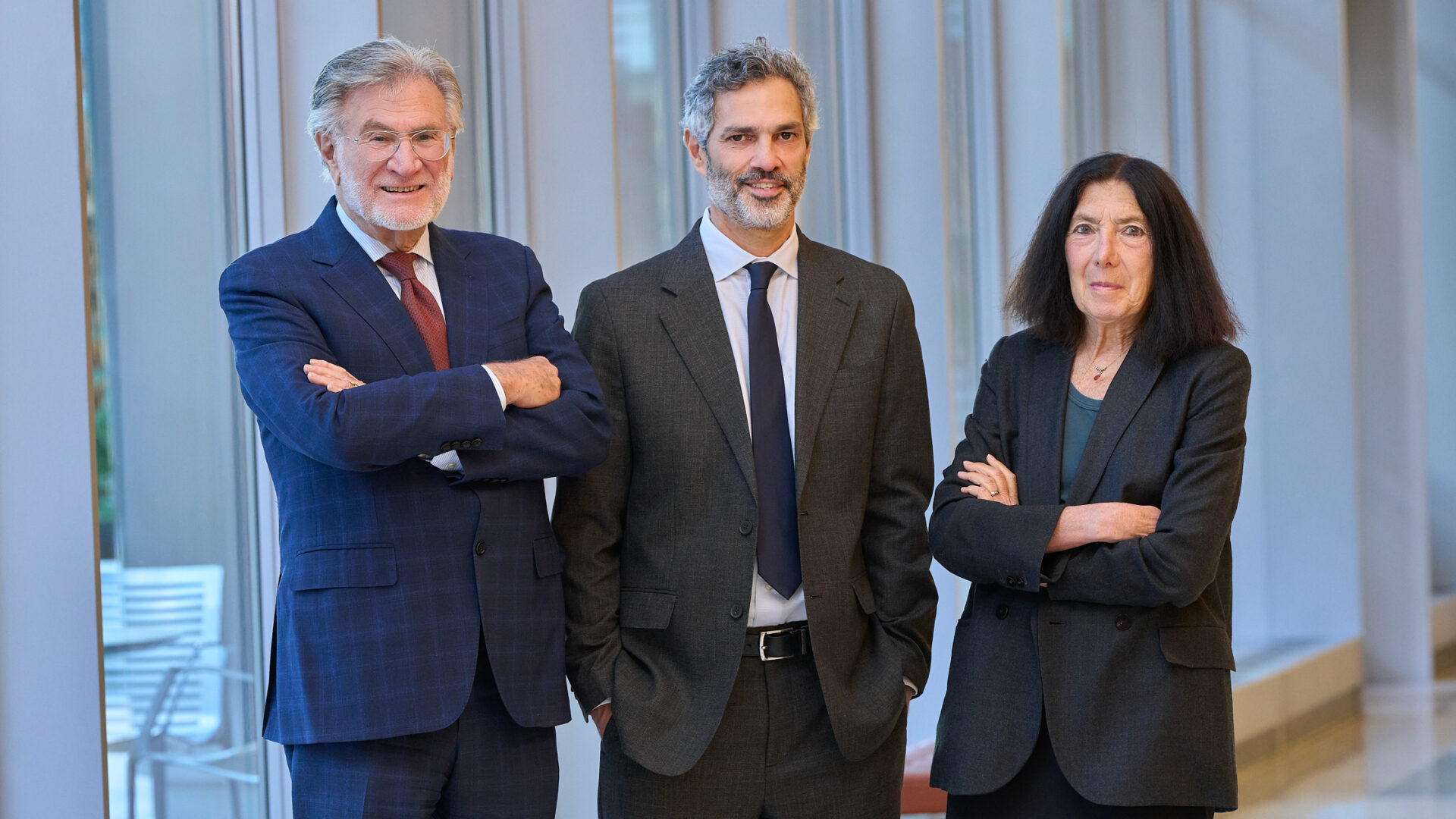
Steven Abramson, MD, chair of the Department of Medicine and executive director of the Colton Center, says the center’s unique strength also comes from emphasizing high-risk, high-reward pilot studies, translational science, and strategic academic–industry collaborations.
“Our commitment and strategic investment have led to exceptional outcomes,” Dr. Abramson says. To date, $8.5 million in center research funding has led to more than $25 million in direct awards from the NIH and contributed to more than $82 million in total federal and non-federal funding. “The return on investment speaks volumes about the strength and impact of our work,” he says.
VEXAS Syndrome Discoveries
Geneticist David B. Beck, MD, PhD, is already an acknowledged leader in the field of monogenic autoimmune and autoinflammatory diseases. Dr. Beck was recently named the junior associate director of the Colton Center in recognition of his significant contributions to autoimmunity research.
In 2020, after Dr. Beck received both his MD and PhD at NYU Langone and completed a postdoctoral fellowship at the NIH, he and collaborators reported in the New England Journal of Medicine on the discovery of a new disease called VEXAS syndrome. Caused by mutations in the UBA1 gene within blood cells, the disease can spur severe inflammatory and hematologic consequences. With support from the Colton Center, Dr. Beck has organized one of the only international meetings dedicated to VEXAS syndrome and is leading the first clinical trial for the disease, aimed at better understanding the underlying processes.
Disrupting Immune Cell Communication in Autoimmunity
The Colton Center is helping to retain promising young talent as well. Elliot Philips, MD, PhD, began as an MSTP student at NYU Langone, received a T32 training grant from the NIH, returned to the division as a rheumatology fellow after a residency in internal medicine, and is now a Breidenbach Scholar at the Colton Center—a recognition given to promising early-career physician-scientists.
“The return on investment speaks volumes about the strength and impact of our work.”
Steve Abramson, MD
Dr. Philips is exploring the communication between dendritic cells and effector T cells—a key interaction in autoimmunity. Dendritic cells presenting antigens to effector T cells can cause inflammation, fibrosis, or other negative consequences. “He is mapping part of the communication strategy between those two cell types to address the question of whether you can block those channels to mitigate some of the exaggerated molecular interactions,” Dr. Scher says. In a 2024 Science Immunology study, Dr. Philips also showed that PD-1, a key immune checkpoint receptor that limits T cell activation, forms dimers and that stimulating dimer formation might help counter autoimmunity.
AI Collaboration Targets Psoriatic Arthritis
Dr. Scher cites Jimin Tan, PhD, jointly appointed to the Institute for Systems Genetics and the Colton Center, as an example of how close collaborations are identifying and developing talented researchers. In fall 2025, Dr. Tan, the inaugural NYU Colton Center AI Computational Scholar, published a bioRxiv preprint describing Chromnitron, an application that predicts the in silico behavior of cellular and disease-state perturbations by modeling alterations in protein binding and gene expression patterns.
Also in 2025, Dr. Tan received a grant with Dr. Scher and Aristotelis Tsirigos, PhD, co-director of the Division of Precision Medicine, from the Arthritis National Research Foundation (ANRF) to study psoriatic arthritis in twins using the Chromnitron model system. “Dr. Tan is looking at what has changed epigenetically in twins that are either affected or unaffected, and trying to predict which proteins will interact with which open chromatin,” Dr. Scher says.
The project, he says, could open the door to new research directions. “Part of the project is for discovery: what is different in the disease state compared to a healthy state?” he says. “But we are also asking whether any of those open chromatin states and their interactions with proteins are relevant for potential therapeutics.”
Gleaning New Clues from the EHR
Another Colton Center grant has paired Dr. Tsirigos with population health specialist Morgan Grams, MD, PhD, the Susan and Morris Mark Professor of Medicine, and neurosurgeon and AI expert Eric K. Oermann, MD. The team aims to map the landscape of autoimmunity across the entire NYU Langone medical system by using an AI model to analyze electronic medical record (EMR) data. The model combines patient histories, lab results, clinical notes, and medical imaging.
“A second component is that, once we identify these patients, we can further interrogate the EMR to understand why and when people develop autoimmune disease,” Dr. Scher says. The ultimate goal is to use that additional knowledge to improve early detection and diagnosis.
In a related project aimed at surfacing patterns of autoimmune disease, Dr. Tsirigos is developing smartphone applications to better understand factors associated with disease flares. The work is a collaboration with Tel Aviv University, a member of the Colton Consortium for Autoimmunity alongside NYU Langone.
“It’s taking our work to the next level and opening up new possibilities to expand our understanding of autoimmunity.”
Jose U. Scher, MD
The consortium’s ecosystem, Dr. Scher says, fosters cross-center collaborations and brings together academic and industry partners for high-impact, multidisciplinary research. “It’s taking our work to the next level and opening up new possibilities to expand our understanding of autoimmunity,” Dr. Scher says.
Replicating the Synovial Environment on a Chip
The Colton Center has even fostered collaborations beyond the medical center, such as awarding a grant to Weiqiang Chen, PhD, a professor of mechanical and aerospace engineering and biomedical engineering at NYU Tandon School of Engineering.
To study rheumatoid arthritis, Dr. Chen has developed a microfluidic synovium-on-a-chip device as a stand-in for the difficult-to-obtain synovial tissue surrounding the articular space. The bioengineered chip, highlighted at the 2025 American College of Rheumatology annual meeting, includes synovial fluid, fibroblast-like synoviocytes, and immune cells within a 3D hydrogel.
“By re-creating the synovial environment on a chip, we can study cell migration and interactions between inflammatory and synovial cells, identify new drug targets, and predict treatment response,” Dr. Scher says. The team is now adapting the platform to study psoriatic and other forms of autoimmune arthritis. “The ultimate goal,” he says, “is to replicate enough of what goes on in vivo so that you can use it for precision medicine.”