
Case Highlights:
- A patient with medication-resistant essential tremor sought an alternative to DBS.
- After receiving bilateral HIFU, he achieved lasting relief from tremor symptoms.
- NYU Langone’s Center for Neuromodulation offers HIFU to a broad range of patients, including appropriately selected individuals with SDRs as low as 0.30.
In September 2024, a man in his early 70s with essential tremor (ET) consulted functional neurosurgeon Alon Mogilner, MD, PhD. The man’s history of tremors dated to childhood, and he had tried multiple medications, to little avail. Despite a successful career as a chemical engineer and amateur race car driver, his activities of daily living—including eating, drinking, and writing—were severely impaired.
The patient had long been aware of deep brain stimulation (DBS), the gold-standard surgical treatment for medication-resistant ET which involves a device implant. However, after learning about high-intensity focused ultrasound (HIFU), an incisionless alternative, he decided to investigate that avenue.
“HIFU has proven to be a safe and effective alternative to DBS, but it’s crucial to select the right procedure for the right patient.”
Alon Mogilner, MD, PhD
“HIFU has proven to be a safe and effective alternative to DBS for patients who are reluctant to undergo invasive brain surgery, or for those considered too high a surgical risk due to advanced age or medical comorbidities,” Dr. Mogilner notes. “But it’s crucial to select the right procedure for the right patient.”
Assessing Eligibility
At NYU Langone Health’s Center for Neuromodulation—one of the first centers in the country to provide a full spectrum of therapies aimed at modifying abnormal nervous system activity—HIFU evaluation begins with a history, examination, and standardized assessment of symptoms. Throughout the pre- and postoperative process, Dr. Mogilner collaborates with neurologist Michael H. Pourfar, MD, his surgical partner of two decades.
The next step is determining the patient’s skull density ratio (SDR) via CT. A higher SDR indicates greater homogeneity within the skull and better transmission of ultrasound waves. A lower SDR suggests it may be difficult to achieve the temperatures needed for a permanent thalamotomy.
The FDA approved HIFU in 2016 for patients with an SDR of 0.45 ± 0.05 or above, but the agency recently lowered the accepted minimum to 0.30.
“Based on our own experience of successfully treating lower SDRs in appropriately selected patients, we have moved away from using 0.40 as a strict cutoff, particularly in patients for whom DBS is strictly contraindicated,” says Dr. Mogilner. “Our findings indicate that even in patients with borderline SDR values, HIFU can provide meaningful symptomatic relief with a favorable safety profile.”
Treating One Side At a Time
The patient was found to be an excellent candidate for bilateral HIFU and underwent the first stage of treatment in November 2024. To suppress his right-hand tremor, Dr. Mogilner targeted the left ventral intermediate nucleus (VIM) of the thalamus.
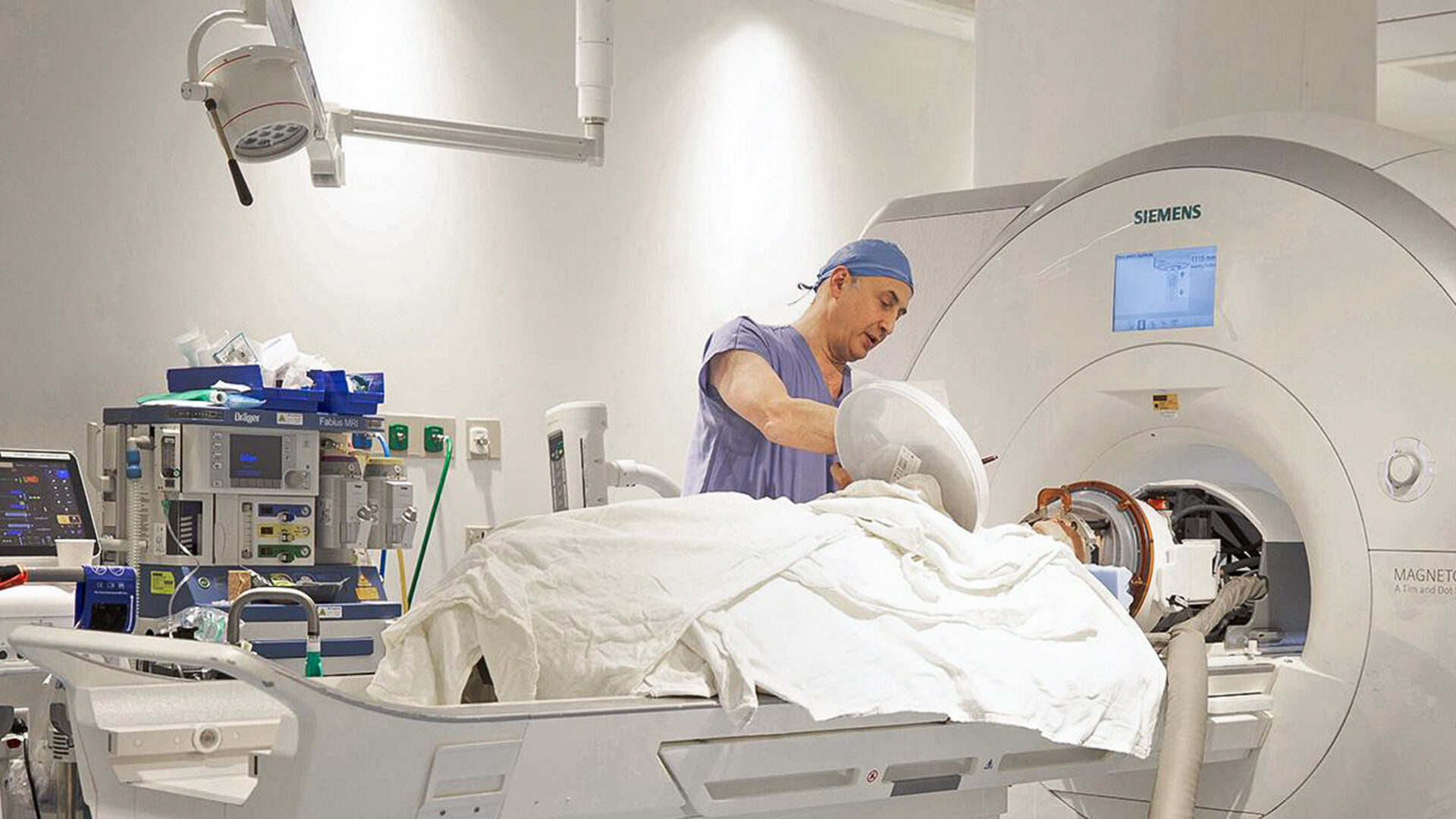
After stereotactic frame placement and MRI confirmation of the target, test sonications at 40º to 50ºC were used to create a transient effect and verify target accuracy. “We watch to see if symptoms improve and if the patient is experiencing any side effects, such as paresthesia or hypoesthesia,” Dr. Mogilner explains. This was followed by therapeutic sonications at 56º to 60ºC—temperatures high enough to ablate dysfunctional brain tissue. To minimize the risk of recurrence, two nearly contiguous lesions were created.
“The patient is very happy. He calls it ‘The Miracle on 34th Street.”
After confirming tremor suppression and a lack of immediate side effects, the team obtained a postoperative MRI. “When the procedure is finished, the impacts are immediate,” Dr. Mogliner says. Just four hours after the patient entered the OR, he could hold his right hand steady for the first time in decades.
He returned home the same day. Aside from mild balance issues that resolved within a few weeks—somewhat common in the postoperative course—his recovery was uneventful.
Sending a Patient Home Tremor-Free
VIM HIFU for ET was initially approved only as a unilateral procedure, due to a high risk of dysarthria and imbalance historically associated with surgical thalamotomies. In 2022, however, the FDA approved bilateral VIM HIFU, stipulating a minimum 9-month window between each procedure. Patients treated at NYU Langone report a 50 to 99 percent improvement in tremor on the second side, with a side effect profile similar to that seen with unilateral HIFU.
The patient returned for HIFU targeting the right VIM in March 2026. Because lesioning the same spot on both sides of the brain has been associated with a higher risk of dysarthria, Dr. Mogilner targeted a location about 1.5 millimeters off-center from the initial site. As before, the procedure went smoothly—and this time, he went home with both hands virtually tremor-free.
Again, the patient experienced only transient postoperative ataxia, and his tremor symptoms remain in remission. “He’s very happy,” Dr. Mogilner reports. “He calls it ‘The Miracle on 34th Street.’”
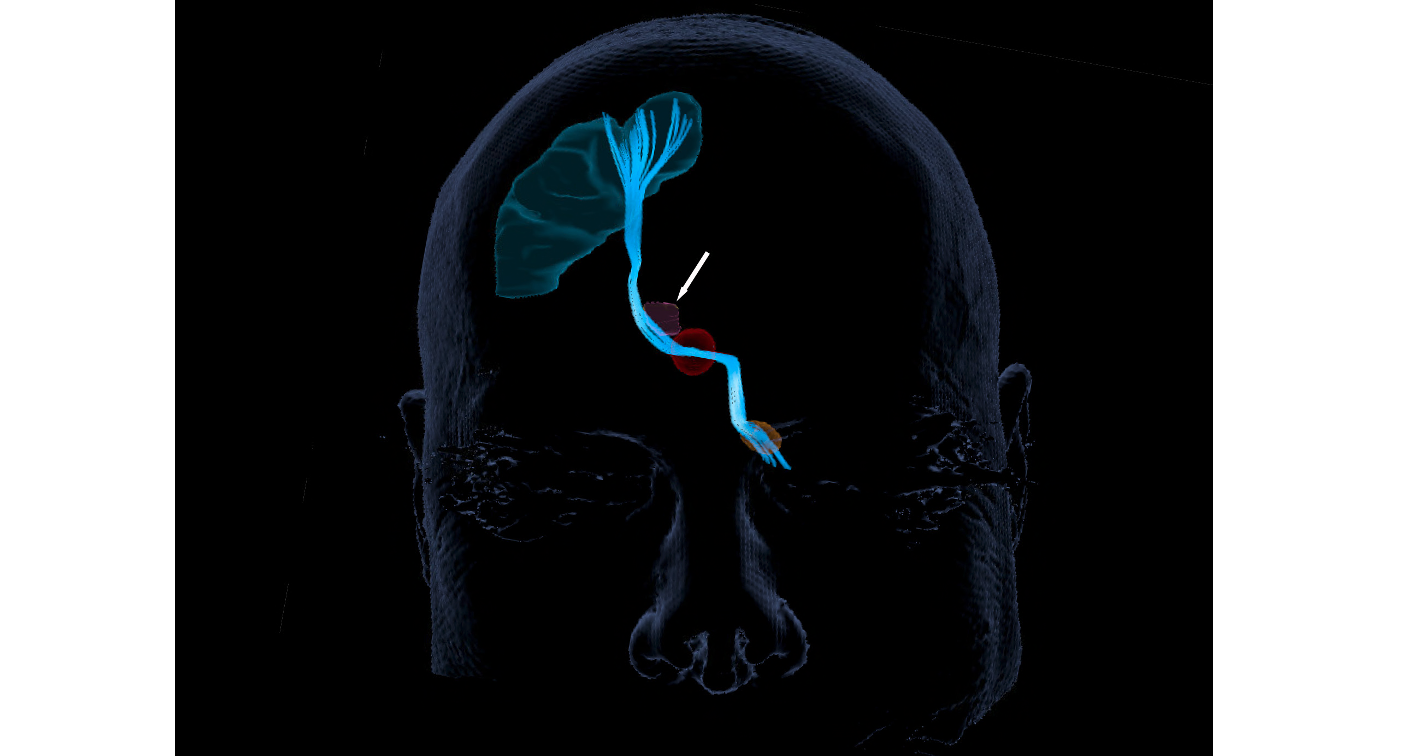
Planning the HIFU thalamotomy via MRI tractography. Target (arrow) is the ventral intermediate thalamic nucleus, visualized as part of the dentato-rubrothalamic tract. Source: NYU Langone Health
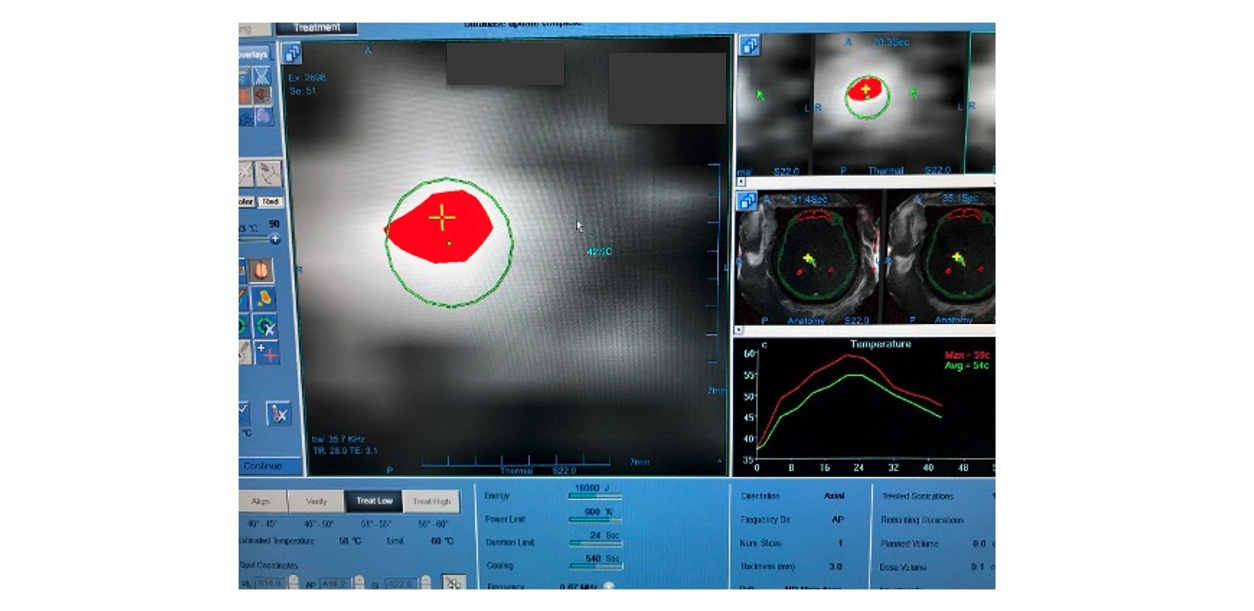
MRI thermography demonstrating thermal lesioning, with heat map of target location and graph of rising temperature. Source: NYU Langone Health
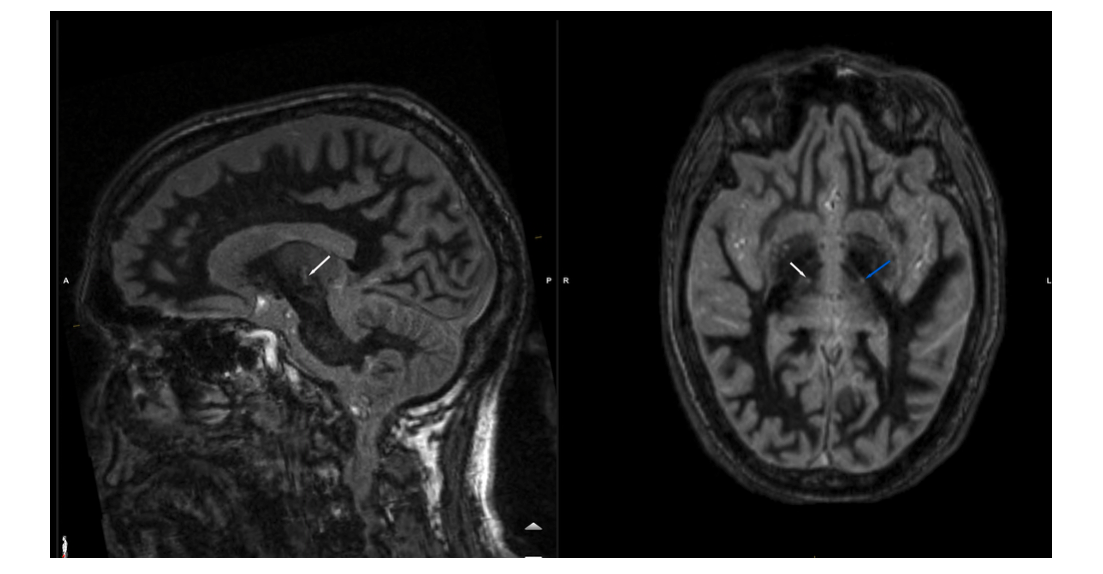
Postoperative MRIs showing new lesion (white arrow) and contralateral previous lesion (blue arrow). Source: NYU Langone Health