

Referral Notes:
- An NYU Langone Heart team performed their first combined mitral TEER and PFA in a patient with severe mitral regurgitation and atrial fibrillation.
- The case represents one of the first combined procedures of its kind performed worldwide.
- An upcoming clinical trial will further evaluate the safety and efficacy of the combined technique.
Atrial fibrillation and mitral regurgitation are closely linked, and their coexistence leads to worse long-term outcomes. Novel technologies, such as pulsed field ablation (PFA) and mitral transcatheter edge-to-edge repair (TEER) have been shown to be safe and effective treatment options for many patients.
While these procedures are typically performed independently, emerging data suggest that concurrent use is not only feasible, but may also improve patient outcomes and resource efficiency.
“Concomitant mitral TEER and PFA may improve survival due to preservation of the atrial contraction and sinus rhythm.”
Larry A. Chinitz, MD
“Concomitant mitral TEER and PFA may improve survival due to preservation of the atrial contraction and sinus rhythm,” says Larry A. Chinitz, MD, director of the Heart Rhythm Center at NYU Langone Health. “It may also improve resource efficiency through symptom improvement and reduced hospitalizations.”
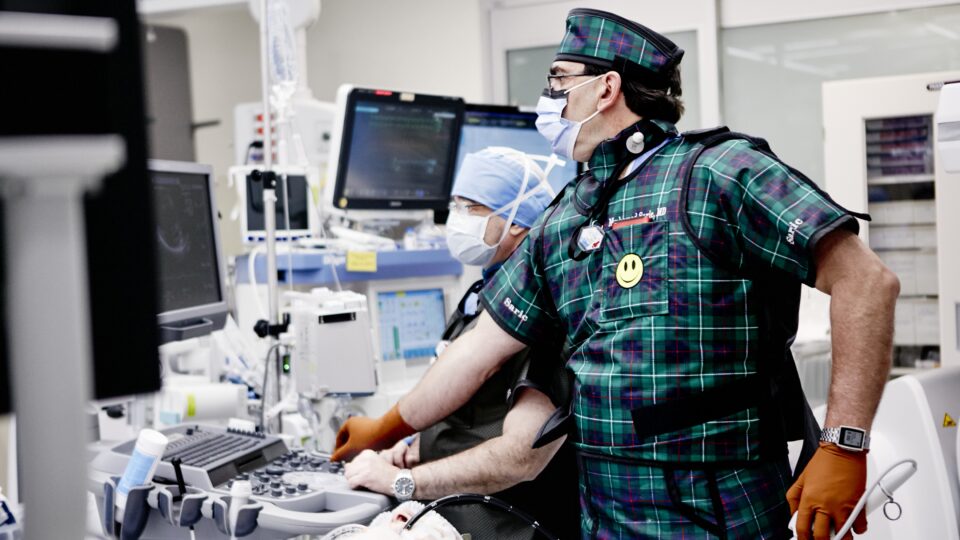
Together Dr. Chinitz and Mathew R. Williams, MD, director of the Heart Valve Center, led an NYU Langone Heart team in performing the medical center’s first combined mitral TEER and PFA in a patient with severe mitral regurgitation and atrial fibrillation, achieving an excellent clinical outcome.
Building Blocks for Progress
PFA is a novel, non-thermal energy source that has been adapted for catheter ablation by a number of manufacturers. The Heart Rhythm Center was one of the world’s first centers to adopt the transformative technology for the treatment of atrial fibrillation.
Transcatheter mitral valve repair with TEER has similarly reshaped treatment for patients with mitral regurgitation. Dr. Williams has performed the most mitral TEER procedures on the East Coast.
“The strong and seamless collaboration between distinct subspecialities at NYU Langone Heart made combining both techniques a no-brainer,” explains Dr. Williams.
“The simultaneous presence of atrial fibrillation and mitral regurgitation adversely affect each condition, and it’s often difficult to determine the predominant pathology,” notes Dr. Chinitz. “Concomitant therapy may address this issue.”
Success for First Patient
Given the growing prevalence of atrial fibrillation in patients with mitral valve disease, it is crucial to improve outcomes for this population. During the procedure, the team worked collaboratively to maximize the likelihood of success while minimizing the risk complications.
First, Dr. Chinitz entered the left atrium transseptally, completed the ablation, and placed a catheter. Then, Dr. Williams proceeded to switch the catheters and perform the mitral TEER.
“These procedures could complement each other very well, but further research is still needed.”
Mathew R. Williams, MD
“The concomitant procedure was fast, seamless, and effective,” says Dr. Williams, “and the patient is doing exceptionally well.”
Future Outlook: Expanding Eligibility
In collaboration with an industry sponsor, Drs. Chinitz and Williams have co-developed a protocol for an upcoming prospective clinical trial that will evaluate concomitant mitral TEER and PFA for patients with severe disease.
According to Dr. Chinitz, patients with less severe mitral disease or paroxysmal atrial fibrillation could also be eligible for the trial in the near future.
“Our long-term goal is to treat patients early on using this intervention,” Dr. Chinitz notes. “It’s still too soon to know whether this procedure can be applied to less severe patient populations. If it can, it’s likely to change the paradigm.”
“These procedures could complement each other very well, but further research is still needed,” Dr. Williams adds.